
Our proposal
Plymouth City Council and Exeter City Council have joined forces to submit a single, shared proposal to Government for local government reorganisation (LGR) in Devon.
Visit our Documents Library to read the full proposal.
Devon is a place of extraordinary character. From two coastlines and two national parks to vibrant cities, rural towns and village communities, it offers a unique blend of landscapes, industries and lifestyles. Yet the way Devon’s local government is organised today no longer reflects how people live their lives, how our economy works, or how modern public services should be delivered.
For over fifty years, Devon has operated under a two-tier system made up of eight district councils and one county council, alongside the existing unitaries of Plymouth and Torbay. This structure divides responsibility for key services and often forces councils to work across multiple, mismatched boundaries. While every council works hard for its residents, the overall system is complex, duplicative, and increasingly unsustainable.
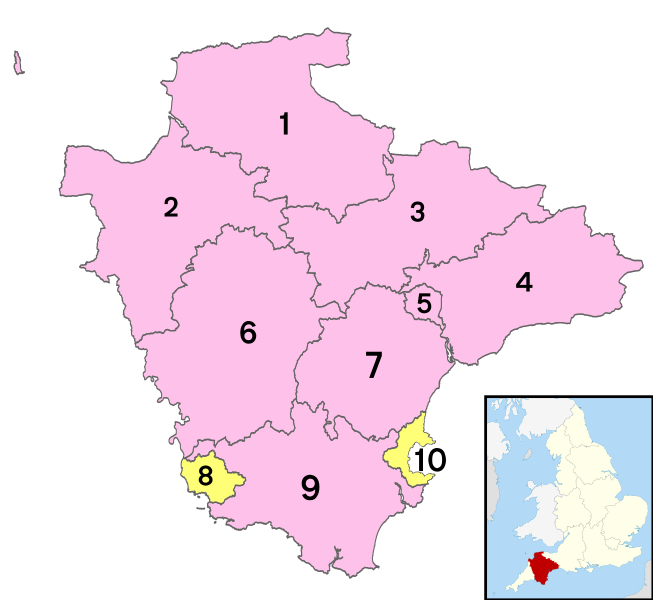
Nilfanion, CC BY 3.0, via Wikimedia Commons.

1 - North Devon / 2 - Torridge / 3 - Mid Devon / 4 - East Devon / 5 -Exeter / 6 - West Devon / 7 - Teignbridge / 8 - Plymouth / 9 - South Hams / 10 - Torbay
In response to the Government’s 2024 English Devolution White Paper and its invitation for proposals, Exeter City Council has developed - alongside extensive evidence and engagement - a proposal for a new local government structure for Devon. This would replace the current eleven councils with four new unitary councils, each responsible for all local services in their area.
The proposed model creates four councils that reflect Devon’s real-world geography - its travel patterns, labour markets, housing pressures, environmental context and community identity. These are:
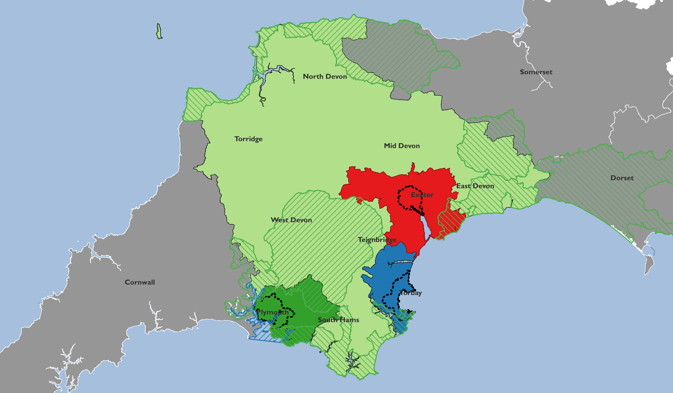
1. An Expanded Exeter Unitary Council
Covering the city and 49 surrounding parishes from East Devon, Mid Devon and Teignbridge.
Population: 260,000 approximately
This reflects Exeter’s true functional economic area - the places where people travel in and out of the city for work, study, leisure, healthcare, and shopping. Exeter’s boundary has not changed since 1966 despite becoming one of the UK’s fastest-growing city economies. With its university, hospital, knowledge clusters and national organisations like the Met Office, Exeter drives prosperity across the wider region. But the city is constrained by its small administrative boundary, making it difficult to plan housing, transport and growth in a coordinated way. Expanding the area to cover the wider community that actually uses the city strengthens services and planning for everyone.
2. An Expanded Plymouth Unitary Council
Extending Plymouth’s existing boundary into 13 South Hams parishes.
Population: 305,000 approximately
Plymouth already functions as a unitary authority, but its economic and social footprint extends well beyond its boundary. Many of its neighbouring parishes look to Plymouth for employment, public services, further education and cultural life. This extension creates a more coherent, balanced population size in line with Government expectations for resilient unitary councils.
3. An Expanded Torbay Unitary Council
Incorporating 21 parishes from Teignbridge and the South Hams.
Population: 232,000 approximately
Torbay is a compact urban area with tightly defined boundaries. The expansion creates a stronger, more sustainable council that reflects Torbay’s wider economic catchment and strengthens its future financial position.
4. A New Devon Coast & Countryside Council
Covering the remaining rural and coastal areas of Devon County Council.
Population: 455,000 approximately
This new authority brings together towns, villages and rural communities with similar needs and characteristics. It supports a more focused approach to the challenges facing dispersed rural populations, from access to services and public transport to housing affordability and social care.
The list of parishes effected in this proposal can be found in our Documents library
Why This Model?
It reflects the way Devon works today
Devon’s housing markets, labour markets and travel patterns cut across old district and county boundaries. People live in one area, work in another, shop in a third and access healthcare in a fourth. The proposed four-unitary model realigns councils around these real connections, not outdated lines drawn over half a century ago. This means decisions will be better informed by how people actually live and move.
It removes the constraints holding our cities back
Exeter, Plymouth and Torbay are the engines of Devon’s economy - but their growth has been stifled by tight administrative boundaries. These constraints have contributed to issues like housing shortages, transport congestion and missed opportunities for coordinated planning. Larger, functional boundaries will allow these cities to manage growth sustainably, helping the entire county.
It strengthens rural identity and avoids splitting communities
The new Coast & Countryside authority keeps parishes intact rather than dividing them. Rural communities retain their identity and representation, supported by a council tailored to rural needs.
It improves financial resilience
Independent financial modelling confirms that each of the four proposed councils would have:
- a viable tax base
- a sustainable population size
- the financial headroom to withstand shocks
- a fair share of resources
- the ability to deliver transformed services
No council is left too large, too small or structurally disadvantaged.
It supports devolution and clearer regional leadership
The four-unitary model works alongside the Devon & Torbay Combined County Authority (DTCCA), giving Government a clearer, stronger partnership for strategic priorities such as housing, transport, skills, business growth and climate action.
It delivers clearer accountability
With one council responsible for every local service in each area, residents will know exactly who does what. No more two-tier confusion.
It respects community identity
By building unitary boundaries out of parish areas, the model preserves long-standing local ties. Towns and villages remain whole.